
A corridor at 03:00, and a question.
By Tom Sieroń, co-founder of SeniorVision and partner at Punktum Digital.
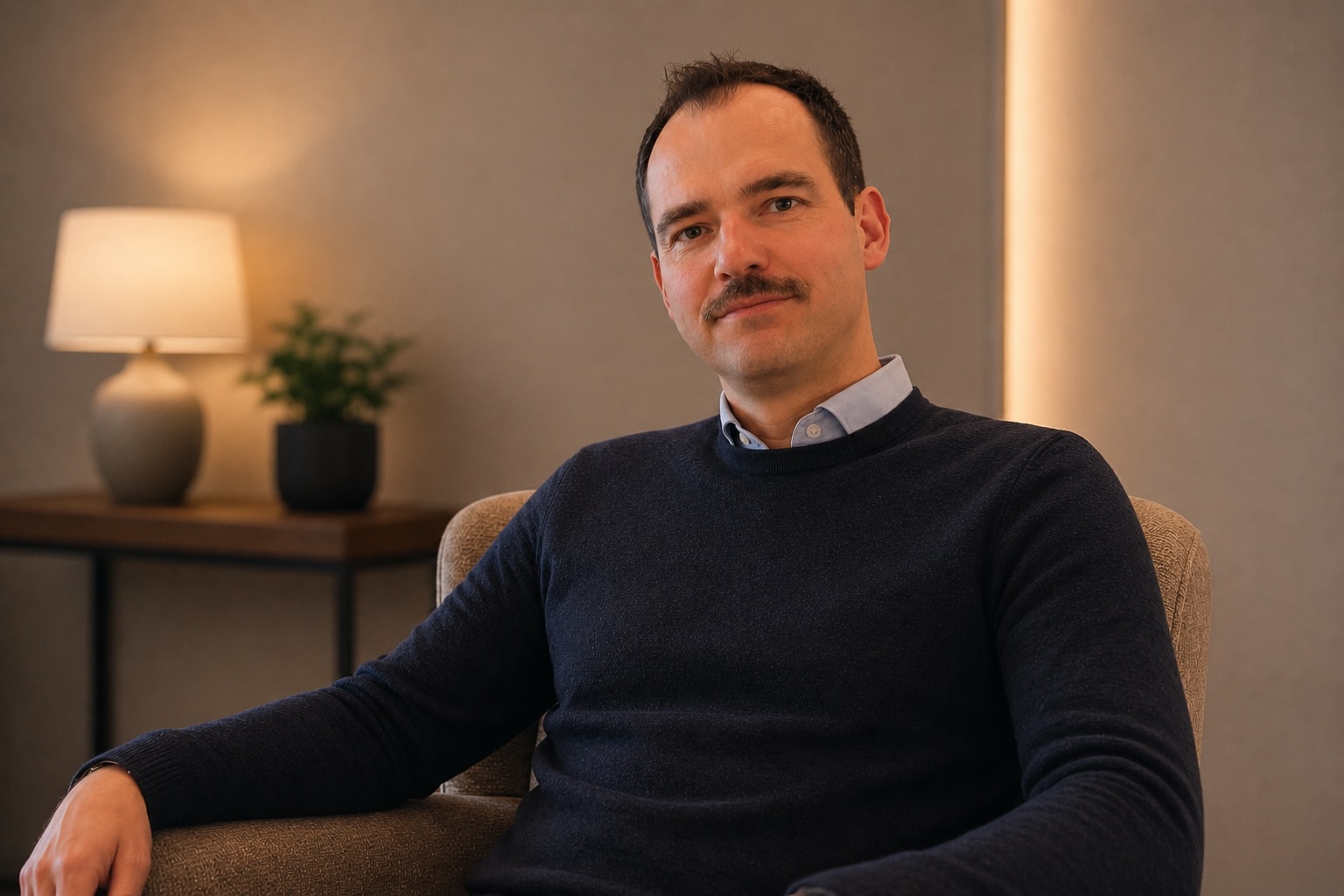
In late 2022, my father Jack had a stroke.
He recovered fast, but then another stroke in 2026 hit him harder. The recovery was uneven, as recoveries often are. There were good months and harder months. There were medications, appointments, gentle adjustments to the rhythm of the day. Me and my mother manage most of it.
When the time came that hospital care was no longer essential, he moved into a care facility. This is the moment in many families' lives that I now know is more common than people realise — the threshold between the home and the institution, crossed not in a single step but through a long, quiet negotiation between what a family can do and what it can't accomplish alone.
I started visiting the facility daily. I am his only child; the responsibility of staying close was straightforward, although it upended my normal life in Berlin for months on end. I learned the ins and outs of the care facility operations very fast. I talked to the doctors, the nurses, fellow patients of my father who lend a helping hand. I learned the frustrations of lack of information and transparency first-hand.
What I noticed in the care facility quickly was that the corridors at certain hours were empty.
Not because the staff were absent — the staff were, by every measure I could observe, doing their best. They were on rounds, on documentation, on handover, serving meals, on the dozens of operational obligations that fill a working shift in a care facility. The corridors were empty because the staff were elsewhere, attending to something necessary. The corridors were empty in the way that, I came to understand, every care facility's corridors are sometimes empty: not from neglect, from the unavoidable arithmetic of staffing.
But what happens in the corridor and rooms that no one is in?
That was the question I started carrying with me, between visits.
I have an unusual background for someone asking that question. I studied biomedical engineering at Gdańsk University of Technology, finishing with honours in 2007. I spent the eighteen years since in product design, service design, and startups — co-founding three companies, mentoring more than two hundred and fifty early-stage founders across Warsaw, Dublin, and Berlin, and serving on the boards of two consultancies that delivered software for global brands and small clinical innovators alike. The biomedical engineering came back into the work in the last decade, when one of the consultancies — Punktum Digital, which I co-founded in Berlin — started focusing exclusively on digital health, wearable diagnostics, and clinical software.
That combination — clinical literacy from the engineering side, fifteen years of building software products from the design and commercial side — turned out to be the right training for the question I was now asking.
Because when I started looking seriously at the senior care technology market, I found two categories of product, and neither answered my question.
The first category was the recording-based monitoring system. Cameras in corridors and rooms, video stored on servers, retrieved by request, accessed by management or by the regulator. The privacy claim in this category was procedural: we have controls, we have policies, we restrict access. The architecture, however, was straightforwardly surveillance — a complete recording of the resident's days, kept somewhere, vulnerable to everything that recordings are vulnerable to.
The second category was the alarm-based device worn by the resident. A pendant, a wristband, a button to press. Useful in a single emergency, but unable to do the thing the empty corridor required: continuous attention, in the absence of staff, that respected the resident's dignity at the same time.
What I could not find — and what every Datenschutzbeauftragte I spoke with, in Germany and Poland, told me they could not find either — was a system that resolved the contradiction. A system that watched the corridor and rooms without recording. That saw the unsteady gait without keeping the footage of the gait. That noticed the prolonged silence in a room and alerted staff, without producing a video that could later be exported, subpoenaed, or breached.
The contradiction is technical, but it is also a design choice. And design choices can be unmade.
Together with my partner Josua Ziegler and the engineering team at Punktum, I started building what would become SeniorVision.
The brief I gave the engineering team was specific. Build a system that watches the corridor and the room, classifies what is happening — a fall, a prolonged silence, an unsteady gait, a wandering at three in the morning — and alerts the staff. Do all of this without ever writing video to disk. Do all of this without ever knowing the resident's name. Make the architecture itself the privacy guarantee, so that no policy change, no breach, no commercial pressure can later compromise it.
This is the architectural commitment that defines SeniorVision. It is not a feature; it is the design. The image data is processed on the edge devices on-site and discarded the moment the next frame arrives. The residents are pseudonymous to the system — they appear as numeric identifiers, with the mapping to their identities existing only on paper, in their rooms, never in the digital system. The staff are identified, with their consent, for compliance reporting only.
The system can do its job — see the unsteady gait, alert the staff, recover the time spent on routine just-in-case rounds — without ever producing the artefact a recording-based system produces. There is no video. There is nothing to retrieve, nothing to export, nothing to breach.
This is harder to engineer than the cloud-recorded alternative. It requires on-premise computation, careful model design, and the discipline to refuse features that would compromise the architecture — a “review yesterday's footage” button that operators sometimes ask for and that the architecture, deliberately, cannot provide. The cheaper engineering path is the recorded model with policy controls layered on top. We chose the harder path because it is the only path that resolves the contradiction.
This is the decision the corridor asked for.
I do not build SeniorVision alone. The engineering depth on the product comes from Punktum's partnership with DAC.digital, where I serve as Chief Revenue Officer — a Polish AI and computer vision consultancy of more than 120 specialists, with five PhDs on staff and ISO 27001 and ISO 13485 certifications. The DeepStream pipeline, the multi-camera re-identification, the model fine-tuning, and the on-premise edge architecture are all the work of engineers and researchers who do nothing else for a living. I supply the product direction and the commercial work; they supply the technical reality.
My partner at Punktum, Josua Ziegler, leads strategy, partnerships, and the institutional conversations. The two of us have known each other and worked together for several years before founding Punktum in 2022. We started the company because we wanted to build digital health products that mattered, and the consultancy was the structure that allowed us to choose what we worked on.
I am writing this in the spring of 2026, ahead of our large scale operator deployments in Germany and Switzerland, scheduled for later in the year.
We expect to be doing this work for at least the next decade.
The work ahead, as I see it, is straightforward. Deploy carefully in each operator partner facilities in Germany and Switzerland. Run every pilot with fresh eyes to surface every operational and regulatory question that real deployment surfaces in a new building, new Bundesland, and new setting. Publish what we learn. Help the operator community develop the institutional vocabulary and the procurement templates that this category of product currently lacks. Develop the team and partners. Hold the architecture.
If you are an operator reading this — a director or an owner of a nursing home, a chain executive, a clinical compliance lead — and you have read this far, I would like to speak with you. Not for a demo. For a conversation about your facility, your staffing reality, your residents, and whether what we are building fits the situation you are actually in. Some operators, after that conversation, decide that SeniorVision is not the right fit. That is a perfectly good outcome. The wrong outcome is a deployment that the architecture cannot honour.
I am Tom Sieroń. The mailbox at the bottom of this page is monitored by me personally.
I would be glad to hear from you.
Write to me directly.
I read every message that arrives at this address. I reply within two working days. The first conversation is about your facility, not about the product.
tom@seniorvision.ai →